This post contains affiliate links. As an Amazon Associate I earn from qualifying purchases at no extra cost to you.
For children with autism, sensory processing can be both a unique challenge and a key area for development.

My son was two years old when I caught him gnawing on the leg of a plastic dinosaur like it was a chicken wing. I laughed it off at first. But when the chewing moved to his shirt collars, his crayons, and eventually the corner of a wooden bookshelf, I stopped laughing and started searching.
I didn’t have the words for it yet. I didn’t know about sensory processing. I definitely didn’t know what oral sensory seeking was. What I knew was that something was driving my child to put everything in his mouth, and no amount of redirecting seemed to stick.
Sound familiar? If you’re nodding right now, you’re not alone. Your child isn’t doing anything wrong. Let’s talk about what’s actually happening and which tools genuinely help.
Key Takeaways
- Up to 90% of autistic children experience atypical sensory processing, including oral seeking behavior (PMC, 2023).
- Oral sensory toys give kids a safe, appropriate outlet for chewing needs, reducing destructive chewing and supporting self-regulation.
- Match chew tool firmness (soft, medium, XT/heavy-duty) to your child’s chewing intensity. Getting it wrong creates either a safety risk or a useless tool.
- Always confirm tool choices with your occupational therapist or speech-language pathologist.
What Are Oral Sensory Issues in Autism?
Up to 90% of autistic children experience some form of atypical sensory processing, according to research published in Frontiers in Neuroscience (PMC, 2023). For many of these kids, the mouth is a primary way they take in and regulate sensory information. That’s why chewing, mouthing, and biting non-food items is so common and so persistent no matter how many times you redirect it.
A 2021 systematic review in the Journal of International Society of Preventive and Community Dentistry found a 90% prevalence of feeding and oral sensory challenges among autistic children (Chaware et al., 2021). That number stopped me the first time I read it. Nine out of ten. This isn’t a quirk. It’s one of the most common autism experiences there is.
Oral sensory issues generally fall into two categories:
- Hypersensitivity (over-responsive): A child gags at certain food textures, refuses toothbrushing, or reacts strongly to unexpected tastes. Their nervous system treats normal oral input as overwhelming.
- Hyposensitivity (under-responsive, or sensory seeking): A child craves more oral input. This is what drives the chewing on shirts, toys, hands, and anything else within reach.
Some kids swing between both. Mine did. Understanding your child’s pattern is the first step to choosing tools that actually work instead of just collecting dust.
Top 10 Autism Oral Sensory Toys
A December 2024 study found that 72.7% of parents of autistic children reported feeding and oral behavior difficulties, with many caregivers describing significant stress around mealtimes and daily routines (PMC, 2024). The right oral sensory toy doesn’t eliminate the need to chew. It gives that need somewhere safe to go. Here are the ten types that occupational therapists recommend most often, and what makes each one different.
1. Chewable Jewelry

Chewable Jewelry
Chewable jewelry (pendants, bracelets, and necklaces made from food-grade silicone) is the most popular category for a simple reason: it’s wearable. The tool goes wherever the child goes, sitting right at mouth level without drawing attention.
Check Price at Amazon ↗Brands like Chewigem and ARK Therapeutic offer pendants in different firmness levels, so you can match the tool to your child’s chewing intensity. Light chewers do well with softer pendants. Strong chewers need something rated XT (extra tough). Start with medium firmness and adjust from there.
Best for: School-age kids who need discreet access to oral input throughout the day.
2. Silicone Teething Tubes

Silicone Teething Tubes
Some children prefer smooth tubes. Others want ridged or bumpy surfaces. If your child abandons chew tools quickly, try a few textures before assuming they don’t like them at all.
Check Price at Amazon ↗Don’t let the name fool you. These aren’t just for toddlers. Silicone teething tubes offer a flexible surface that gives under pressure, which many sensory seekers prefer. They’re often the first tool an OT introduces because they’re easy to clean, inexpensive, and available in different textures.
Best for: Children new to oral sensory tools, or those who prefer softer resistance.
3. Vibrating Oral Massager

Vibrating Oral Massager
These are commonly used in OT and speech-language pathology sessions. If you want to try one at home, ask your child’s OT first. Placement matters. Used correctly, they’re genuinely effective for kids on the hypersensitive end.
Check Price at Amazon ↗Vibrating oral tools work differently from standard chew tools. Instead of biting down, these deliver gentle vibration to the gums, cheeks, and tongue. That vibration can actually help desensitize a hypersensitive child over time, which is useful if your child struggles with toothbrushing or rejects most food textures.
Best for: Kids with oral hypersensitivity or food texture aversions, under OT guidance.
4. Textured Spoons

Textured Spoons
Feeding therapists often use them as a bridge: start with textures the child already tolerates, then slowly introduce new ones. They work best as part of a feeding therapy plan, not as a standalone tool.
Check Price at Amazon ↗Here’s one that surprises a lot of parents. Textured spoons aren’t just feeding tools. They’re sensory tools. The varied textures on the spoon’s surface provide feedback to the lips and tongue during meals, which can help hypersensitive children gradually accept more oral input.
Best for: Children in feeding therapy or those working on food texture tolerance.
5. Oral Motor Chew Tools
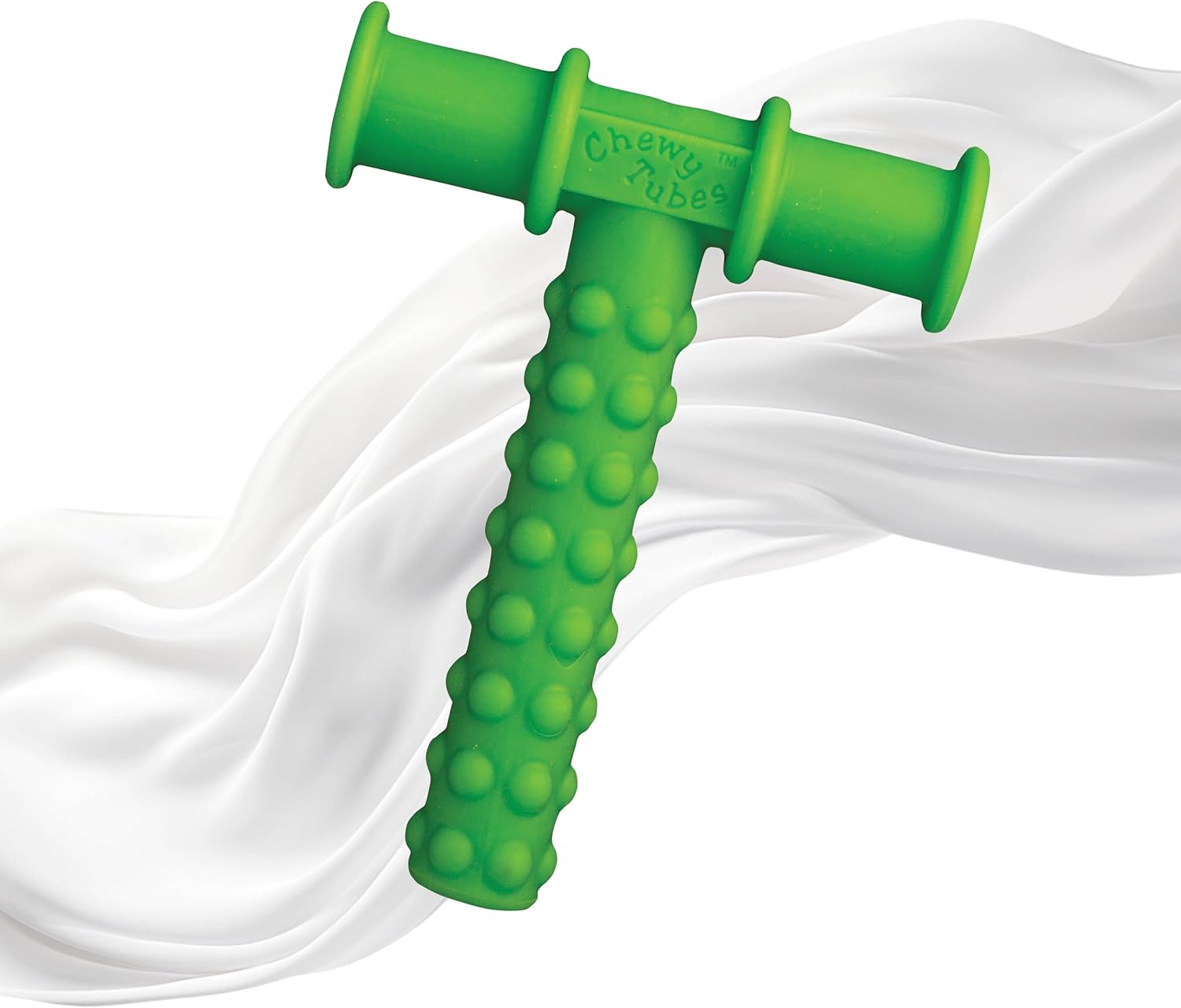
Motor Chew Tools
Oral motor chew tools, like ARK’s Y-Chew or the Grabber, are designed specifically for therapeutic use.
Check Price at Amazon ↗Their shapes reach back molars where children often apply the most chewing force, and they’re built to withstand heavy use without breaking into pieces (a real safety concern when kids chew improvised objects instead).
These tools support jaw strengthening and can improve speech articulation over time. Many speech therapists incorporate them into articulation exercises. Look for tools with an intensity rating system so you can step up firmness as your child’s needs change rather than replacing the whole tool.
Best for: Stronger chewers, or children with speech articulation goals.
6. Flavored Chew Sticks

flavored chew sticks
Flavored chew sticks add a multisensory dimension: taste plus texture plus oral pressure.
Check Price at Amazon ↗That combination can be more engaging than plain silicone for some kids. Common flavors include mint, cinnamon, and fruit. The taste component makes them particularly useful during snack time or homework sessions when a child needs extra regulation support.
Worth noting: the flavor wears off. Once it fades, some children lose interest quickly. Keep a few varieties on hand so you can rotate and maintain engagement.
Best for: Children motivated by taste, or anyone who gets bored with unflavored tools.
7. Rubber Pencil Toppers

pencil toppers
Bright and stylish pencil toppers offer a discreet way to support concentration during homework or note-taking.
Check Price at Amazon ↗Rubber pencil toppers are the workhorse of oral sensory tools. Simple. Durable. Effective for heavy chewers. They’re often the recommendation when a child has been destroying softer tools or chewing through clothing, because the firmer resistance provides the deep proprioceptive input a strong sensory seeker actually needs.
Ideal for individuals with autism, ADHD, SPD, or sensory needs, they help promote calmness and improve focus by providing oral motor stimulation.
Best for: Heavy chewers who have outgrown or destroyed softer tools.
8. Oral Sensory Balls

oral sensory balls
These tend to be a good starting point for younger children who aren’t ready for pendant-style tools yet.
Check Price at Amazon ↗Oral sensory balls are textured, flexible balls sized appropriately for the mouth. The variety of bump patterns, ridges, and nubs gives rich tactile input to the tongue and gums. They’re also useful for oral motor exercises. Rolling the ball across the tongue, for example, builds tongue lateralization skills that support both speech and feeding.
Best for: Younger children and those working on tongue movement and coordination.
9. ARK’s Grabber Oral Motor Tool

oral motor tool
If your child is actively in OT or speech therapy and you want one tool that professionals will recognize and know how to work with, this is it.
Check Price at Amazon ↗The ARK Grabber deserves its own entry. It’s one of the most recommended tools by occupational therapists and speech-language pathologists, and for good reason. Its T-shaped design reaches back molars comfortably, the gentle texture provides consistent input without overstimulating, and it comes in multiple firmness levels: standard, XT, and XXL. It’s made from FDA-registered food-grade material.
Best for: Any child in active OT or speech therapy who needs a clinically-supported tool.
10. Z-Vibe Vibrating Pen Tool

vibrating pencil tool
Speech therapists use it to improve awareness and movement of the lips, tongue, and jaw. It’s the most versatile tool on this list and one worth asking your SLP about specifically.
Check Price at Amazon ↗The Z-Vibe from ARK Therapeutic is shaped like a writing instrument and accepts interchangeable tips, from a smooth bump tip for desensitization to a chewy tip for sensory input. Because it looks like a pen, older children often find it more socially acceptable than pendant-style chew tools.
Best for: Older children and tweens who want something low-key, or those working on speech-related oral motor skills.
What Are the Therapeutic Benefits of Oral Sensory Toys?
The mouth processes more than taste. It’s a primary sensory organ tied directly to the nervous system’s ability to regulate arousal, focus, and emotional state. A 2025 systematic review in Frontiers in Pediatrics found emerging evidence supporting sensory-based interventions for reducing maladaptive behaviors and improving daily participation in autistic children (Frontiers in Pediatrics, 2025).
Oral sensory toys support regulation in three overlapping ways. Chewing activates the jaw’s proprioceptors, sending calming signals to the nervous system, much like deep pressure does elsewhere in the body. Having an appropriate outlet also reduces the anxiety that builds when the urge to chew is constantly redirected away from everything in sight. And some tools directly strengthen the oral motor muscles used in speech and feeding, creating developmental benefits beyond regulation alone.
Enhanced Focus and Attention
Chewing satisfies an underlying sensory need, freeing up cognitive resources that were previously going toward managing that need. Many parents and teachers notice that kids with access to appropriate chew tools stay engaged in tasks longer. This is especially noticeable during homework or classroom activities that require sustained attention. The tool doesn’t need to be in their mouth the entire time. Having it available is often enough.
Calming and Emotional Regulation
The rhythmic motion of chewing activates the parasympathetic nervous system, the same system engaged by deep breathing or rhythmic rocking. For a child in sensory overload, access to a chew tool can be the difference between a managed moment and a full meltdown. It works best when the child has the tool available before they reach overload, not after. Think of it as preventive, not reactive.
Support for Speech Development
Oral motor chew tools, vibrating tools, and textured tools can all strengthen the specific muscles used in speech. Jaw strength, lip closure, and tongue lateralization directly affect how clearly a child produces sounds. Research from the 2021 systematic review found that 60% of autistic children experience moderate-to-severe language challenges (Chaware et al., 2021). Your child’s SLP can guide you on which tools target the specific areas they’re working on. Not all oral tools are equivalent here.
How Do You Choose the Right Oral Sensory Toy?
Choosing well comes down to three things: chewing intensity, context, and professional input. Occupational therapy guidance consistently recommends matching chew tool firmness to a child’s observed chewing force, with light, medium, and heavy-duty options available across most established brands (ARK Therapeutic). Get the firmness wrong and the tool either breaks (safety risk) or doesn’t satisfy the need (useless).
Here’s a quick matching guide:
- Light chewers (mostly mouthing, minimal actual biting): Start with soft silicone pendants or teething tubes.
- Moderate chewers (some biting, chews through softer materials): Try medium-firmness chew necklaces or flavored chew sticks.
- Heavy chewers (destroys shirt collars, tears through soft toys): Go with XT-rated silicone or rubber chew tubes. Don’t skip straight to the heaviest option without working up to it.
Context matters too. A vibrating oral massager used at home under OT supervision is different from a chew necklace your child wears to school all day. Match the tool to the setting and the moment.
And please, talk to your child’s occupational therapist or speech-language pathologist before purchasing. They can assess your child’s specific oral motor profile and recommend tools that align with therapy goals. A tool that helps one child may do nothing for another, even with the same diagnosis. This is one of those areas where one-size-fits-all advice breaks down fast.
If you’re still figuring out your child’s sensory profile, it helps to work with an occupational therapist who has experience in sensory integration. You can read more about what that looks like in our guide to occupational therapy for autism and our breakdown of in-home autism therapy options.
Frequently asked questions about oral sensory toys for autism
Oral sensory toys are tools designed to provide safe, appropriate oral stimulation for children who seek sensory input through their mouths. For autistic children who chew on clothing, hands, or non-edible objects, these toys provide a safe alternative that meets their sensory needs while protecting them from harm.
Chewing provides proprioceptive input to the jaw and mouth a calming, organizing sensation for many autistic children. It can help with focus, anxiety regulation, and sensory seeking. Rather than trying to stop the behavior entirely, providing an appropriate chew tool redirects it safely.
The best chew toy depends on your child’s chewing intensity and preferences. Light chewers do well with softer silicone options. Strong chewers need firmer, more durable tools — ARK Therapeutic makes a range specifically rated by chewing intensity. Always consult your child’s occupational therapist for a personalized recommendation.
Yes! chewable jewelry designed specifically for sensory needs is made from non-toxic, food-grade silicone and is safe for children. Look for products that are BPA-free, phthalate-free, and latex-free. Always supervise young children with any chew tool and replace it if it shows signs of wear or damage.
Some oral sensory tools, particularly vibrating toothbrushes and oral motor tools, can help strengthen the muscles used in speech and support oral motor development. This is an area where your child’s speech-language pathologist can provide the most specific guidance based on your child’s individual profile.



[…] Opt for gifts that stimulate curiosity and comfort without overwhelming the senses. Consider tactile toys that encourage gentle touch, like soft fabric books for young children or stress-relief squishies for older kids. Visual simplicity can also be key; look for items with soothing colors and uncomplicated designs that provide visual interest without the chaos. Auditory gifts might include musical instruments with soft, harmonious tones, or sound machines that emit nature sounds, promoting a calm environment. […]